
The “They” We Keep Talking About
What if some of today’s racial tension is not being driven by people who know each other, but by people who barely know each other at all?

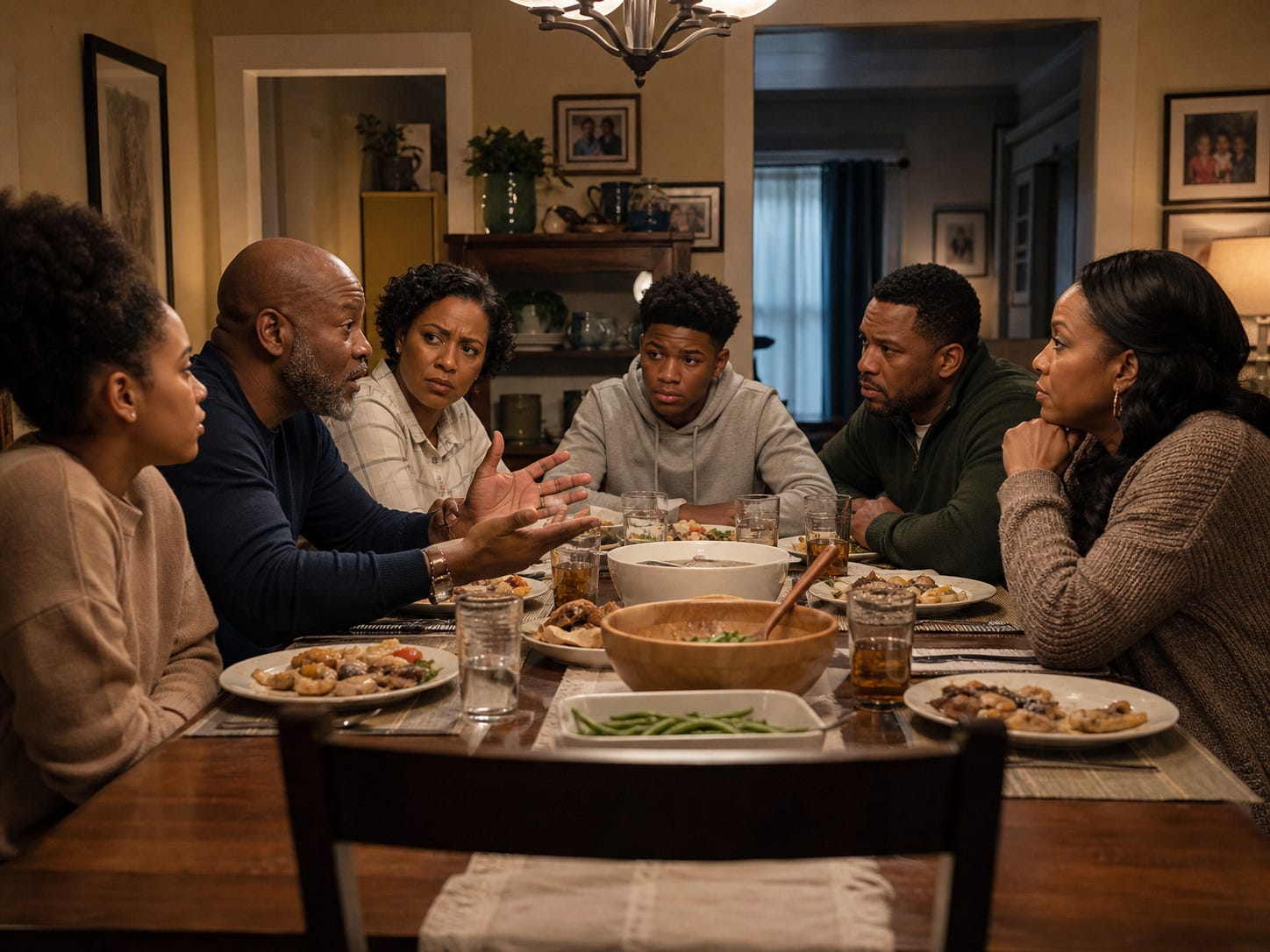
There is a conversation Black people have been having for a very long time.
Sometimes it happens at the dinner table. Sometimes it happens after church. Sometimes it happens in barbershops, on porches, at family gatherings, or in private conversations between friends. The words may change, but the meaning is often the same.
“They don’t want us to win.”
“They will never let us have anything.”
“They are always trying to keep us down.”
“They are coming after us again.”
Most Black people know exactly who “they” means, even when no name is attached to it. The word usually points toward White people, White institutions, White power, or some vague combination of all three. It is a small word carrying a heavy load.
I understand where it comes from.
There was a time in this country when “they” was not imagined. “They” had names, offices, laws, uniforms, banks, schools, courtrooms, police departments, and political power. “They” wrote laws. “They” denied loans. “They” blocked neighborhoods. “They” enforced segregation. “They” made sure certain doors remained closed.
No honest person can pretend that history did not happen.
However, that is not the question.
The question is whether we are still living as if it is always happening in the same way, with the same force, by the same people, every day, everywhere, all the time.
That question makes some people uncomfortable because it challenges a familiar story. It does not excuse racism or deny prejudice. It does not claim every door is equally open or that every person is treated fairly. Life is not that simple.
It does ask whether some of us have given too much power to an enemy that may not be thinking about us nearly as much as we think they are.
That is one of the most overlooked racial truths in America today.
Black people often talk about White people. White people may not be talking about Black people with anywhere near the same intensity.
That does not mean White Americans are innocent of every prejudice. It does not mean racial bias has vanished, or that every concern Black people raise is false. It does mean the mental and emotional burden may not be equal.
Many Black Americans move through life with a constant racial awareness. We read the room. We notice tone. We watch how we are treated, and listen to what is said and sometimes what is not said. We inherit stories from parents and grandparents who had good reason to warn us. We are taught to be careful, to pay attention, to not assume acceptance.
For some, that awareness becomes wisdom.
For others, it becomes a prison.
At some point, caution can become suspicion. Suspicion can become resentment. Resentment can become a worldview. Once that worldview settles in, almost everything becomes evidence.
If a door closes, “they” did it.
If a business fails, “they” blocked it.
If a child struggles, “they” designed it.
If a neighborhood declines, “they” caused it.
If we do not build, own, save, marry, teach, invest, or prepare, somehow “they” still remain the explanation.
That kind of thinking is dangerous because it removes responsibility from us while pretending to protect us. It may feel like racial awareness, but often it becomes surrender dressed up as insight.
The truth may be more complicated and more uncomfortable.
In 2026, many White Americans are not sitting around plotting against Black people. Many are dealing with their own marriages, mortgages, aging parents, health problems, job pressures, wayward children, inflation, retirement fears, and spiritual emptiness. Many are not consumed with Black progress or Black failure. They are consumed with their own lives.
That does not make them noble. It makes them human.
The same is true in reverse.
Many Black Americans are not sitting around plotting against White people. We are trying to raise children, pay bills, build something, keep families together, bury loved ones, stay healthy, and make sense of a country that struggles to really understand us.
The tragedy is that many of us are forming opinions about each other without actually knowing each other.
We live in the same country, but not always in the same communities. We work in the same economy, but not always in the same networks. We may shop in the same stores, cheer for the same teams, and sit in the same traffic, yet never sit across a table from each other long enough to become real people.
That distance creates room for imagination. Imagination, when fed by fear, becomes suspicion. Suspicion, when repeated long enough, becomes belief. Belief, when protected from real relationships, becomes almost impossible to challenge.
This is where media makes everything worse.
If a White person does not know many Black people personally, what picture does he receive? Too often, he sees Black America through crime stories, protests, political arguments, athletic success, entertainment culture, poverty coverage, and carefully selected outrage. He may never see the ordinary Black father leaving for work before daylight. He may never see the Black grandmother holding a family together. He may never see the Black business owner carrying payroll on his back. He may never see the Black church feeding people every week.
If a Black person does not know many White people personally, what picture does he receive? Too often, he sees White America through old history, political conflict, police encounters, workplace suspicion, social media arguments, and family warnings passed down over generations. He may never see the White father worried about his son. He may never see the White mother praying over a sick child. He may never see the White neighbor who would help if asked. He may never see the White family barely holding on financially while being told they are privileged beyond struggle.
When people do not know each other, they do not have relationships strong enough to correct the caricatures.
A real friendship makes propaganda harder to believe.
Once you have eaten at a man’s table, met his wife, laughed with his children, prayed with him, worked beside him, or helped him through grief, it becomes harder to reduce him to a racial category. He may still be wrong about things. He may still have blind spots. He may still carry assumptions. So might you. Yet he is no longer just “them.”
He has a name.
That matters.
I am not naïve. Friendship will not solve every racial issue in America. Good manners will not erase every bad policy. A few handshakes will not undo every disparity. People can know each other and still disagree deeply. Still, it is hard to build trust with people we only know through television, politics, and inherited suspicion.
There is also a responsibility inside the Black community that we must be willing to discuss honestly. We cannot keep telling our children that “they” are the reason for everything and then act surprised when our children grow up either angry, defeated, suspicious, or passive. We cannot teach them that the world is permanently rigged against them and then expect them to pursue excellence with confidence. We cannot keep pointing outward while ignoring the habits, decisions, and disciplines that are within our control.
There is a difference between teaching history and teaching helplessness.
Our children should know what happened. They should know about slavery, segregation, redlining, and the long struggle for equal citizenship. They should know the courage of those who endured more than we can imagine. They should know the price that was paid for the freedoms we now enjoy.
They should also know that they are not trapped in 1965. They are not powerless. They are not waiting for permission from White people to build a life. They do not need to carry every wound of every generation as if it happened to them personally this morning.
That may sound harsh, but I believe it is necessary. A people cannot move forward if every conversation keeps dragging them backward. Memory matters, but memory must serve wisdom. It cannot become a chain.
White Americans have their own responsibility.
It is not enough to say, “I do not hate anybody,” while knowing almost nothing about the lives, concerns, families, churches, struggles, and aspirations of Black people. Indifference is not the same as innocence. Distance may not be hatred, but distance can still leave people ignorant. It can make it easy to dismiss concerns because they do not come from someone you love.
A White person who has no real Black friends may believe he understands Black America because he watches the news, works with a few Black people, or follows a few commentators online. That is not the same as knowing people. It is information without relationship.
A Black person can make the same mistake.
He may believe he understands White America because he knows history, watches politics, and has worked around White people for years. That also is not the same as knowing people. Proximity is not intimacy. Shared space is not friendship.
This is part of the reason racial conversations in America often go nowhere. We are not always speaking from relationship. We are speaking from camps.
One side says, “You do not understand what has happened to us.”
The other side says, “Why are you still blaming us?”
One side says, “This country has never treated us fairly.”
The other side says, “I never owned slaves and I am struggling too.”
Then the argument goes in circles because both sides are often responding to categories instead of people.
The word “they” keeps the distance alive.
“They” is useful when describing systems, history, or broad patterns. Sometimes the word is unavoidable. But when “they” becomes the main way we describe living human beings, we should be careful. It allows us to accuse without naming, fear without examining, and resent without relationship.
It also allows us to avoid harder questions.
What are we building?
What are we teaching?
What are we tolerating?
What are we passing down?
What have we blamed on others that may now belong to us?
What have we accepted as normal that is damaging our own families?
These questions do not let anyone else off the hook. They put us back on the hook for our own lives. That is where I believe the conversation needs to go.
America may always have racial tension at some level because human beings are tribal, sinful, proud, and easily manipulated. Politics will keep using race because it works. Media will keep amplifying conflict because conflict attracts attention. Activists will keep finding enemies because enemies help movements survive. Commentators will keep stirring fear because fear keeps people watching. The rest of us have to decide whether we are going to live that way. We have to decide whether we want to inherit every suspicion, repeat every accusation, and pass every grievance to the next generation untouched. We have to decide whether we are willing to know people well enough to complicate our assumptions.
That does not require us to be foolish. It does not require us to ignore reality. It does not require Black people to pretend racism never existed or White people to walk around apologizing for being White.
It requires honesty, maturity, and enough courage to admit that some of what we believe may be incomplete.
Maybe part of the racial problem in America is due to the fact that we do not know each other, yet we keep talking as if we do.
Maybe too many Black people are still talking about “they” as if “they” are gathered in secret rooms plotting our destruction.
Maybe too many White people are not talking about Black people at all, except when politics or media forces the subject into their lives.
That imbalance creates resentment on one side and confusion on the other. One group feels watched, judged, blocked, and threatened, while the other group feels accused, blamed, and tired of a conversation it may not even understand.
Nothing healthy grows in that soil.
At some point, we have to tell the truth. Not the comfortable truth, the political truth, or the truth that gets applause from our side.
The real truth.
Many of us are carrying stories about people we barely know. Until that changes, “they” will remain powerful. Not because “they” always deserve that power.
Because we keep giving it to them.
GOD BLESS YOU CECIL, ABSOLUTELY BRILLIANT, ON POINT POST! IHOPE A TON OF FOLKS READ THIS!...mike
True! I'll add that many people use their imaginations to fill in the gap of barely knowing each other. Skin pigment is a stand-in for all sorts of imaginary differences. I'm a pale southerner, and I can guarantee I have more culture in common with my fellow southerners of all skin pigments than I do with people of any skin pigment level from New England. My first time visiting NE felt like a foreign trip. The imaginary differences are used as a blame comes from all sides. I'm a 65-yr-old woman and I have whiplash from the changes I've seen from the 60's to now, but I haven't forgotten the automatic victimhood screeched anytime a black and/or woman got a decent job. No evidence needed to convince "they" of unfairness. It's human to want the benefits of being part of a group, and sometimes that group is by default (family), profession, church, situation, etc., but oftentimes it's chosen based on superficial factors that could benefit. Humanity can do wonderful things but can also be fairly ridiculous.